The process
The solar panel installation process, step by step
Most of what makes a solar installation go well or badly happens before and after the day the panels go up. Here is the whole process in order, with what an MCS certified installer has to do at each stage and what you should ask.
Checked at source on 3 November 2026 · Published by SEO-DONS LTD
The stages
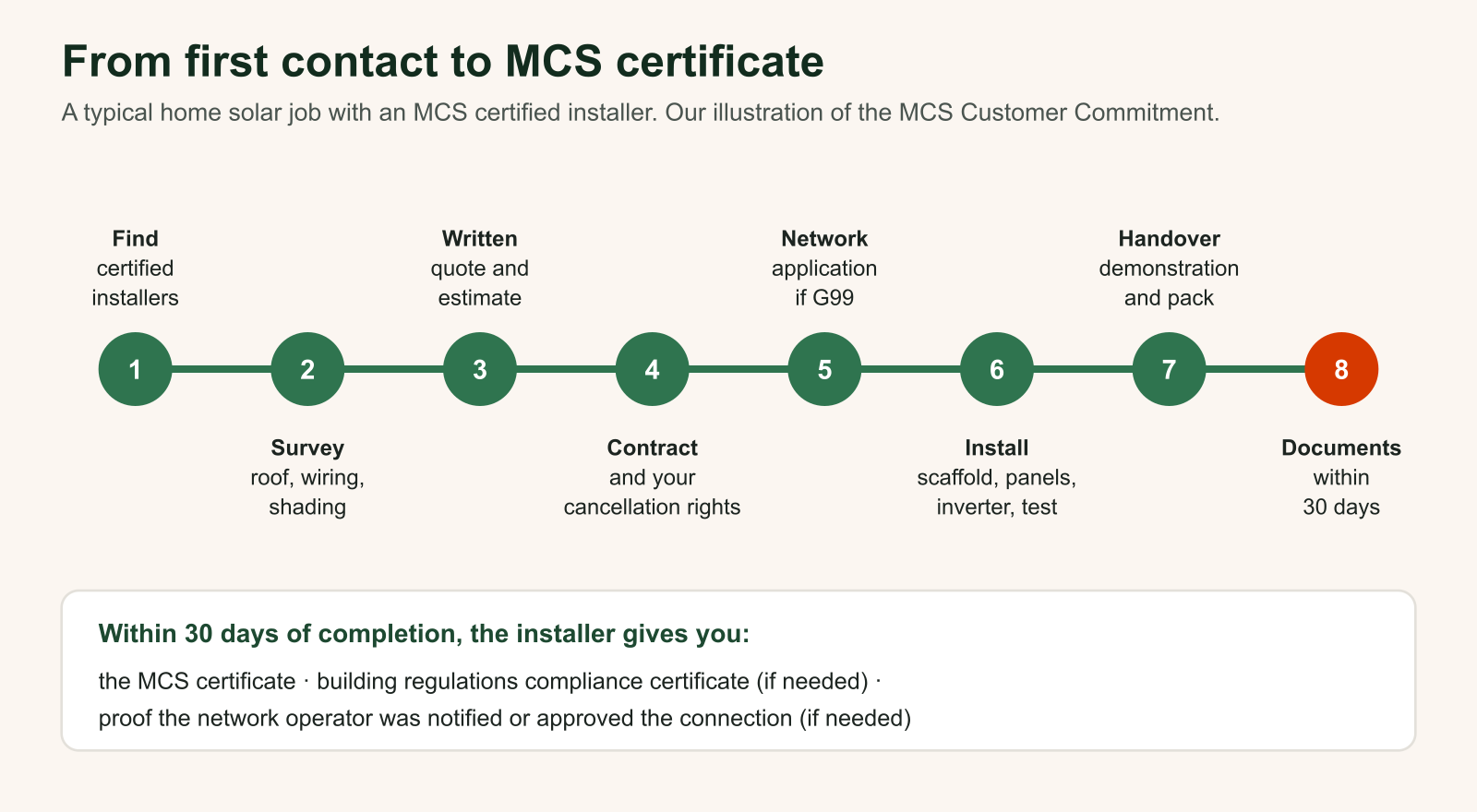
Eight stages, in order
- Finding installers. Search the MCS register by postcode and technology, check consumer code membership, and shortlist three firms.
- The survey. Someone looks at the roof, shading, structure, consumer unit and meter, and asks about your electricity use.
- Quote and estimate. A detailed written quote with product details and a realistic performance estimate, plus a copy of the MCS Customer Commitment.
- Contract. Clear terms, a reasonable and protected deposit, dates, and your cancellation rights explained.
- Network application. For larger systems, the installer applies to the network operator under G99 and waits for approval.
- Installation. Scaffolding, mounting, panels, wiring, inverter, connection and testing.
- Handover. A demonstration, an agreed way to control the system, and a handover pack.
- Paperwork. Within 30 days: MCS certificate, any building regulations certificate, proof of network notification.
Before you sign
Survey, quote and contract
The survey is where a good installation starts. The installer needs to see the roof and its condition, check for shading, look at the loft and cable route, and inspect the consumer unit and meter. They should also ask about your household and how you use electricity, because MCS asks installers to clearly define your requirements, and the design and estimate depend on them.
The written quote follows. It should name the products, give the full price with any extra work priced, and include a realistic performance estimate. With it should come a copy of the MCS Customer Commitment, which the installer must give you before you commit to anything.
The contract turns the quote into obligations: what the installer will and won't be responsible for, a payment schedule, any deposit and how it is protected, dates, and your cancellation rights. If you signed at home or online, the Consumer Contracts Regulations normally give you 14 days to cancel a service contract. See contracts and cancellation.
If the design changes
Changes between the survey and the work
Sometimes a detailed design, done after you sign, differs from what was quoted: different panels, a different layout, a lower estimate, a later date. The MCS Customer Commitment deals with this directly. The installer must give you a written variation to the contract. If the change is significant, you must be given the choice to continue with the new terms or cancel without further cost, and get back any deposit or pre-payment.
The same applies, subject to the contract, if unforeseen work comes up, such as a roof repair or a consumer unit upgrade: you should be told promptly, with the effect on cost and timing, and given a variation.
Keep every variation with your contract.
The network
Telling the network operator
The law requires the local network operator to be told about a generator that runs in parallel with the network, before or at the time it is commissioned. Systems up to 16 A per phase, about 3.68 kW on a typical single-phase home, are notified under the G98 procedure within 28 days of installation. Larger systems, including many panels-plus-battery systems, need a G99 application and approval before installation, which can add weeks.
Your installer normally handles this, and must give you proof of notification or approval within 30 days of completion. See network notification explained.
The day
Installation day, roughly
Scaffolding usually goes up first, sometimes a day or more ahead. The installers fix the mounting to the roof, place and wire the panels, run the cable to the inverter, install isolators and protection, connect to the consumer unit and fit the generation meter. They then test and commission the system. For a typical home this takes a day or two; complex roofs or a battery can add time.
The MCS Customer Commitment asks installers to take care while working, clean up properly and dispose of waste responsibly, and to make sure any subcontractors, such as scaffolders, are competent and insured. See how long it takes.
Who does what
Your part and the installer's, stage by stage
| Stage | The installer | You |
|---|---|---|
| Survey | Inspects the roof, shading, wiring and meter | Gives accurate information about the home and your use |
| Quote | Written quote, product details, realistic estimate, Customer Commitment | Compares at least three; checks the registers |
| Contract | Clear terms, deposit protection, cancellation rights | Reads it before signing; keeps a signed copy |
| Permissions | Explains permissions and notifications, and who handles each | Makes sure necessary permissions are in place |
| Installation | Works safely, keeps you updated, cleans up | Provides access; tells them of special requirements |
| Handover | Demonstrates the system, hands over the pack and certificates | Keeps the documents for the system's life |
After
Handover, and what to do if something isn't right
At handover the installer should show you how the system works, how to set it up and use it, and agree the most effective way to control it for your needs. They should check you're happy with the work and agree a date for anything outstanding.
If something is wrong, tell the installer first and give them reasonable time; MCS suggests 14 days as a reasonable maximum for a response. If it isn't resolved, MCS handles complaints about certified installers. See when something goes wrong.
Then
Export payments and your records
With the MCS certificate and a suitable meter, you can apply to a licensed supplier for an export tariff under the SEG. Keep the certificate, the handover pack and the warranties together for the life of the system; you'll need them for export payments, any claim and when you sell the home.
Process questions
How long does the whole process take?
It varies with the installer’s workload and whether a G99 application is needed. The installation itself usually takes a day or two once scaffolding is up; the paperwork follows within 30 days.
When do I pay?
According to the payment schedule in your contract. Any deposit should be reasonable, justified and part of an agreed schedule, and the installer must tell you how it is protected.
What if the design changes after the survey?
An MCS installer must give you a written variation to the contract. If the change is significant, you can choose to continue or cancel without further cost and get any deposit back.
Do I need to be at home?
You need to give access and agree what access the installers need, such as the loft, the consumer unit and where scaffolding goes. Someone should be there for the handover.
Keeping track
A simple record of the job
Keep one folder, paper or digital, for the whole job: the quotes you compared, the signed contract and any variations, the deposit receipt, emails about dates and network approval, photos of the roof before and after, the handover pack and, within 30 days, the certificates. It takes a few minutes at each stage and it is the single most useful thing you can have if anything needs putting right, or when you come to sell the home.
Sources for this page
- MCS — The MCS Customer Commitment, version 1.1 (8 September 2026) read 3 November 2026
- MCS — guidance on notifying network operators (G98 and G99) read 3 November 2026
- legislation.gov.uk — ESQCR 2002, regulation 22 (generation in parallel with the network) read 3 November 2026
- legislation.gov.uk — Consumer Contracts Regulations 2013, regulation 30 (cancellation period) read 3 November 2026
- RECC — consumer top tips read 3 November 2026
- Ofgem — SEG guidance for generators (PDF) read 2 November 2026
Ready for a solar panel quote?
Tell us about the house and the roof, and what you would like priced: panels, a battery or both. If an installer has already quoted, add the system size and the price. Your details reach SEO-DONS LTD, which runs Solar Panel Installers, and we reply by email.
What happens next
- Your details go to SEO-DONS LTD, the company that runs Solar Panel Installers.
- We read what you have told us about the house and reply by email.
- Asking for a quote costs nothing and puts you under no obligation.