Finding installers
Solar panel installers near you: how to find good ones
Search results for solar installers near you are mostly adverts and directories that sell leads. The registers run by the schemes themselves are a better starting point: they're free, they cover the whole UK, and they show what each firm is actually certified for.
Checked at source on 3 November 2026 · Published by SEO-DONS LTD
Step one
Start with the MCS installer search
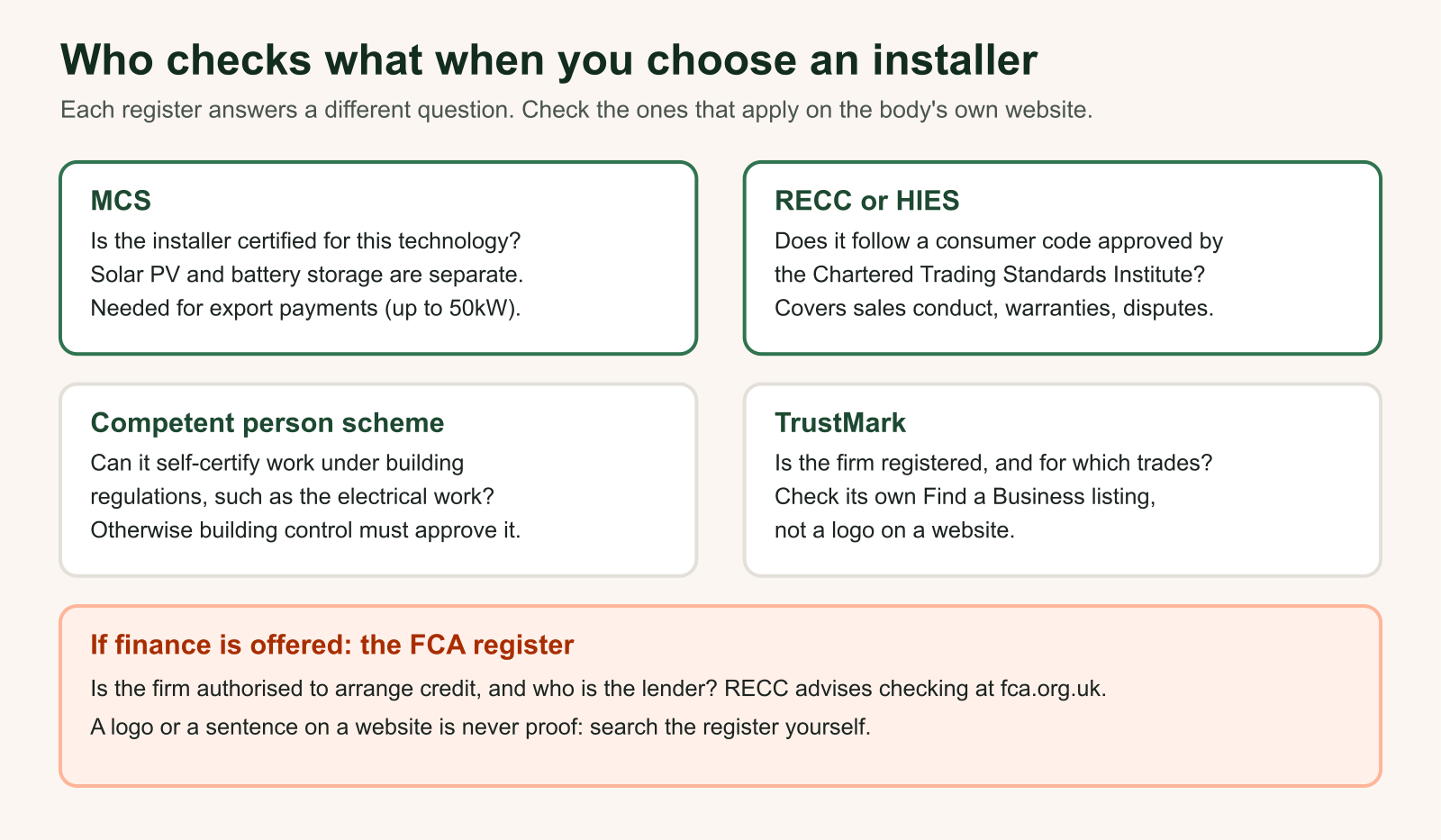
MCS is the UK's quality mark for small-scale renewable energy technologies, including solar PV and battery storage. Its installer search lets you look up certified firms by postcode and by technology. Searching by technology matters: certification is given for named technologies, and a firm certified for solar PV is not automatically certified for battery storage, which is a separate MCS technology.
There's a practical reason to insist on MCS as well as the quality one. To receive export payments under the SEG for a solar system of up to 50kW, the installation and the installer must be MCS certified, or certified under an equivalent scheme. A system fitted by an uncertified firm can leave you without that income.
The register is also your check on claims. MCS installers must use the MCS mark only for the services they are certified for. If a website shows the mark next to something the register doesn't list, ask why.
Step two
Check the consumer code
MCS certification is about technical competence. A consumer code is about how a firm treats you: how it sells, what its contracts say, how it protects deposits and what happens if things go wrong. The codes that cover solar installers are approved by the Chartered Trading Standards Institute; RECC and HIES are the two you are most likely to see.
RECC says its members are vetted before acceptance and checked to make sure they are not phoenix companies, are given legally backed model documents, are forbidden from unfair selling tactics, and must offer a workmanship warranty of at least two years with financial protection if the installer can't put things right or stops trading. HIES describes its accredited installers as operating under a CTSI-approved consumer code, held to standards of customer service, transparency and protection.
Both have member searches on their own websites. Use those, not a logo on the installer's site. For what each scheme means in more detail, see MCS, RECC and HIES explained.
Step three
The other registers worth a look
| Register | Look it up when |
|---|---|
| Competent person scheme | The firm says it will self-certify the electrical or other work under building regulations |
| TrustMark | The firm shows the TrustMark logo: check its Find a Business listing, and for which trades |
| FCA register | The firm offers to arrange finance |
| Companies House | You want to see how long the company has existed and who runs it |
GOV.UK explains that you don't need building regulations approval yourself if the work is done by someone registered with a competent person scheme for that type of work.
Shortlisting
From a list of names to three firms worth inviting
A postcode search can return many firms. To narrow them down, look for these:
- Certification that fits the job: solar PV, plus battery storage if you want one.
- A consumer code you can confirm on the code's own search.
- A clear identity: the company's legal name and address on its website, and a Companies House record that matches.
- A survey before a quote: firms that offer a price without looking at your roof or electrics are guessing.
- Reviews you can test: RECC suggests speaking to past customers directly if you can, and being wary of reviews that are vague or overly positive.
Then invite three. RECC recommends at least three quotes from three different installers, compared on price, timescales and warranties.
Before anyone visits
What to have ready, and what to expect
Have a year of electricity bills or your smart meter readings to hand, know roughly how many people live in the home and when you use most electricity, and mention any plans such as an electric car or a heat pump, which can change the system that suits the home. MCS asks customers to give installers accurate information on exactly these points, because the system design and performance estimate depend on them.
From a good installer, expect the order set out in how an installation works: a survey, then a written quote with the product details, the full price and a realistic performance estimate. Expect a copy of the MCS Customer Commitment before you commit to anything. And expect to be left to decide in your own time: MCS installers must not pressure you to sign, and RECC tells consumers never to accept a discount for signing on the spot.
When the quotes arrive, compare them side by side.
Why certification pays
The register, export payments and your paperwork
Certification isn't just reassurance. The MCS certificate an installer gives you within 30 days of completion is the document energy suppliers ask for before paying for exported electricity under the SEG. It also records the system for when you sell the home. Choosing a certified firm at the start is what makes that paperwork possible at the end.
For the paperwork you should receive, see maintenance and aftercare.
Finding an installer
Where can I search for MCS certified solar installers?
On the MCS website’s installer search, by postcode and technology. Choose solar PV, and battery storage too if you want a battery.
Is a local installer always better?
Not necessarily. Local can make aftercare easier, but a proper survey, clear written answers and a firm commitment to put things right matter more than distance.
Should I trust installer reviews?
Use them with care. RECC suggests being cautious of reviews that look overly positive or vague, paying attention only to sources you trust, and speaking to past customers if you can.
What if an installer isn’t on the MCS register?
Then the installation can’t be MCS certified by that firm, which matters for export payments on systems up to 50kW. Ask the firm directly; if it claims a certification you can’t find on the register, RECC suggests challenging it.
Comparison and directory sites
Sites that "find installers for you"
Many sites offer to match you with local installers. Some are genuine directories; many are lead-generation businesses that pass your details to firms that pay for them, sometimes several at once. That isn't wrong in itself, but you should know which you're dealing with before you hand over your phone number. Look for who runs the site, whether it says it sells enquiries, and what it does with your details.
The scheme registers don't sell your details: you search them and contact the firms yourself. That puts you in control of who calls and when.
A firm's history
Checking a company on Companies House
Companies House shows when a company was formed, its directors, its registered office and whether its accounts are up to date. A very new company isn't a problem on its own, but a firm that claims years of experience under a name registered last month, or whose directors have run several companies that closed, deserves questions. RECC says it checks members aren't phoenix companies; the register lets you look for yourself.
Sources for this page
- MCS — find a certified installer read 3 November 2026
- MCS — The MCS Customer Commitment, version 1.1 (8 September 2026) read 3 November 2026
- RECC — information for consumers read 3 November 2026
- RECC — consumer top tips read 3 November 2026
- HIES — Home Insulation and Energy Systems consumer code read 3 November 2026
- TrustMark — logo misuse and checking a business read 2 November 2026
- GOV.UK — competent person schemes read 3 November 2026
- Ofgem — SEG guidance for generators (PDF) read 2 November 2026
- MCS — Installer Operating Requirements, Issue 2.0 (September 2026), PDF read 2 November 2026
Ready for a solar panel quote?
Tell us about the house and the roof, and what you would like priced: panels, a battery or both. If an installer has already quoted, add the system size and the price. Your details reach SEO-DONS LTD, which runs Solar Panel Installers, and we reply by email.
What happens next
- Your details go to SEO-DONS LTD, the company that runs Solar Panel Installers.
- We read what you have told us about the house and reply by email.
- Asking for a quote costs nothing and puts you under no obligation.