The installation
Domestic solar panel installation: what gets installed
A home solar system is more than panels on a roof. Behind them is an inverter, a run of cable, protective switches, a connection into your fuse board, metering and paperwork. Knowing the parts makes quotes easier to read and survey questions easier to ask.
Checked at source on 3 November 2026 · Published by SEO-DONS LTD
On the roof
Panels, mounting and the roof itself
Panels are rated by their output in watts under standard test conditions; the system size in kWp is the total of the panels' ratings. The quote should name the make, model and power rating of the panels, which the MCS Customer Commitment requires to be stated in the contract.
Most domestic panels are fixed on rails above the existing tiles or slates, attached to the rafters with brackets that pass under the roof covering. Some installations sit within the roof, replacing an area of tiles. Either way the roof covering is disturbed, so the installer should check its condition at the survey, and tell you if the work might affect any existing roof warranty. MCS requires installers to tell you that in writing and get your written permission before going ahead.
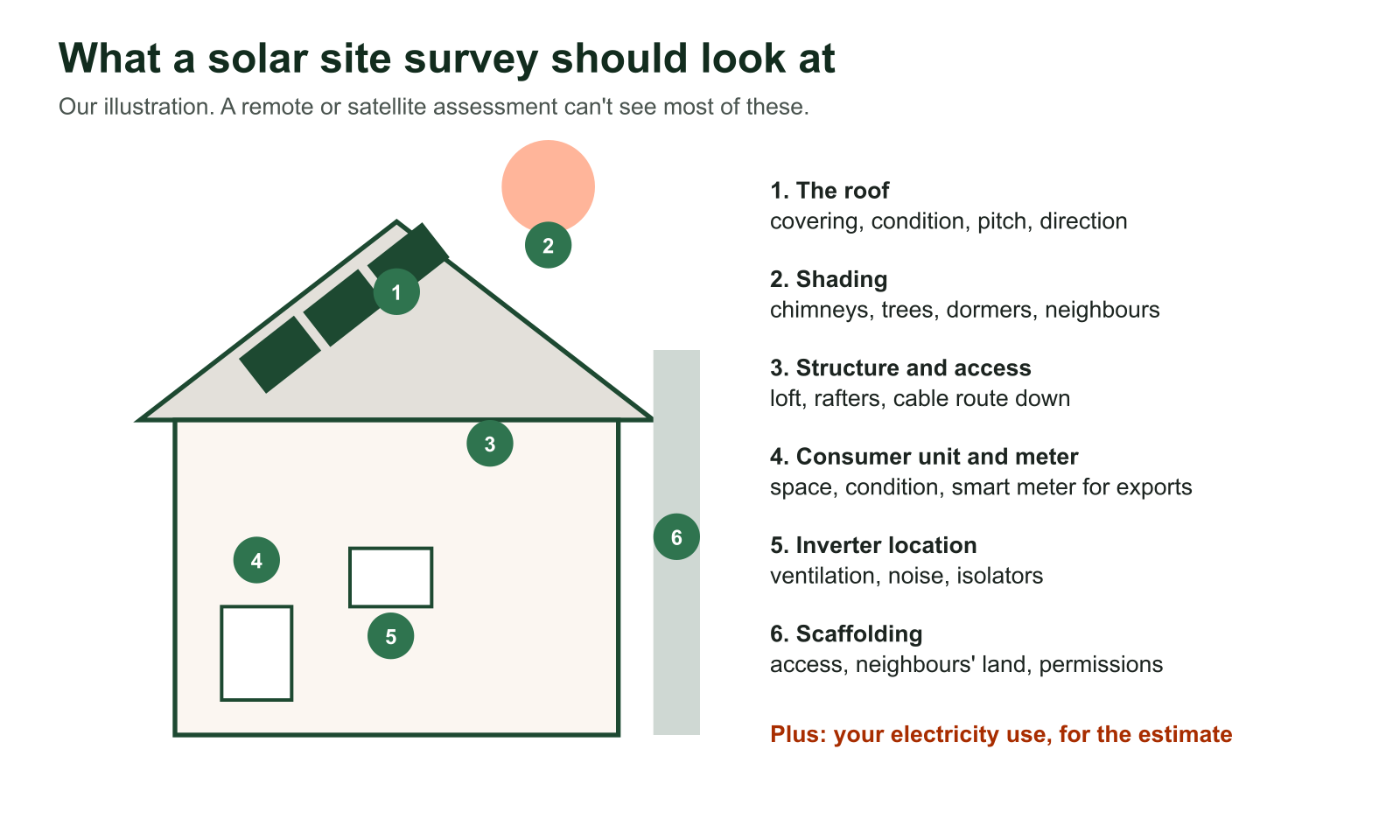
The survey should also look at shading from chimneys, dormers and trees, because shade on part of an array can reduce its output. How the panels are wired, and whether optimisers or microinverters are used, is partly a response to shading. See the site survey.
In the house
The inverter, wiring and protection
Solar panels produce direct current. The inverter converts it into the alternating current your home uses and the grid carries. It is usually mounted in a loft, garage or utility area, and its location affects ventilation, noise and how easy it is to reach. A hybrid inverter can also manage a battery.
Between the panels and the inverter, and between the inverter and your consumer unit, are isolators so the system can be switched off safely, plus protective devices. The connection into your consumer unit is electrical work that normally needs to meet building regulations; installers registered with a competent person scheme can self-certify it, and otherwise building control approval is needed.
Finally there is metering: a generation meter recording what the panels produce, and, for export payments, a meter able to record exports half-hourly, usually a smart meter.
The parts list
What a domestic solar quote usually covers
| Part | What it does | What the quote should say |
|---|---|---|
| Panels | Generate direct current | Make, model, power rating, number of panels, total kWp |
| Mounting | Fix the panels to the roof | On-roof or in-roof; any roof repairs priced separately |
| Inverter | Converts to household alternating current | Make, model, rating; where it will go |
| Optimisers or microinverters | Manage panels individually, often for shade | Whether they are included, and why |
| Isolators and protection | Make the system safe to switch off | Included in the electrical work |
| Metering | Records generation and exports | Generation meter; whether a smart meter is needed |
| Scaffolding | Safe access to the roof | Included or extra; who provides it |
| Battery (optional) | Stores electricity for later | Usable capacity; separate MCS certification for the installer |
Adding a battery
If a battery is part of the job
A battery stores surplus solar electricity for use later in the day. It adds cost, space and its own safety requirements, and it changes the network notification: panels and a battery on the same connection add together, and MCS notes the combination will often take a system beyond the threshold for the simpler G98 notification.
Battery storage is a separate technology under MCS. Check on the register, as described in finding an installer, that the firm is certified for it as well as for solar PV, and that the quote states the battery's usable storage capacity, which the MCS Customer Commitment requires where applicable. If you're comparing quotes, ask for the battery to be priced separately so the solar part can be compared like with like.
See reading the kit list for the terms on battery specifications.
Permissions and notifications
What the installer should sort out, and tell you
Before you sign, an MCS installer must tell you all the permissions, approvals and licences the job needs, and explain what must be notified under building regulations and who is responsible. For most homes, roof-mounted solar falls within permitted development, with limits and conditions; listed buildings and conservation areas are where care is most needed. See planning and building regulations.
The network operator must be told about any generator that runs alongside the network, before or at the time it is commissioned. Small systems are notified under G98 within 28 days; larger ones need a G99 application, and approval, before installation. See network notification.
What it's for
How the system pays its way
A domestic system lowers your bills mainly by supplying electricity you would otherwise buy, during daylight. Any surplus goes to the grid, and under the SEG a licensed supplier pays for exported electricity if the installation is MCS certified and exports are metered. A battery can shift some daytime surplus into the evening.
How much each of these is worth depends on your use, your tariff and your export rate, which is why the performance estimate should show its assumptions. Installing solar in a home is zero-rated for VAT until 31 March 2027, then 5%.
Common worries
Questions people ask before agreeing to an installation
Will the roof leak? Fixings pass through the roof covering, so workmanship matters. Ask how the installer will weather the fixings, and check the workmanship warranty.
What if the inverter fails? The inverter has its own manufacturer's warranty, usually different from the panels'. Check both, and what the installer's workmanship warranty adds.
Is my fuse board suitable? The survey should check. An upgrade, if needed, should be priced on the quote, not discovered on the day.
After installation
What you should be left with
A demonstration of how the system works, a handover pack with the list of key parts, health and safety guidance, a maintenance schedule, the manufacturers' manuals and all guarantees and warranties. Then, within 30 days, the MCS certificate, any building regulations certificate and proof of network notification. See maintenance and aftercare and the process step by step.
Domestic installation questions
What does a domestic solar installation include?
Usually the panels and their mounting, an inverter, cabling with isolators and protection, a connection into your consumer unit, generation metering, and scaffolding for the roof work. A battery is optional and certified separately under MCS.
Can solar panels affect my roof warranty?
They can. An MCS installer must tell you in writing if the installation might invalidate an existing warranty, such as a roof warranty, and get your written permission first.
Do I need a smart meter?
To be paid for exports under the SEG, exports must be metered by a meter that can record half-hourly readings, which usually means a smart meter.
Who tells the electricity network about my panels?
Normally the installer. Small systems are notified under G98 within 28 days; larger ones need a G99 application before installation. Ask who is responsible, in writing.
Sources for this page
- MCS — The MCS Customer Commitment, version 1.1 (8 September 2026) read 3 November 2026
- MCS — Installer Operating Requirements, Issue 2.0 (September 2026), PDF read 2 November 2026
- MCS — guidance on notifying network operators (G98 and G99) read 3 November 2026
- legislation.gov.uk — ESQCR 2002, regulation 22 (generation in parallel with the network) read 3 November 2026
- Ofgem — SEG guidance for generators (PDF) read 2 November 2026
- HMRC — VAT Notice 708/6, energy-saving materials read 3 November 2026
- GOV.UK — building regulations approval: when you need it read 3 November 2026
- GOV.UK — competent person schemes read 3 November 2026
- Planning Portal — solar panels and planning permission read 3 November 2026
Ready for a solar panel quote?
Tell us about the house and the roof, and what you would like priced: panels, a battery or both. If an installer has already quoted, add the system size and the price. Your details reach SEO-DONS LTD, which runs Solar Panel Installers, and we reply by email.
What happens next
- Your details go to SEO-DONS LTD, the company that runs Solar Panel Installers.
- We read what you have told us about the house and reply by email.
- Asking for a quote costs nothing and puts you under no obligation.